Best Snow Chains for 2026 (Buy Them Now, Not at the Base of the Pass)
The tire chains and textile socks worth owning before the first storm, how cable, diamond, external, and fabric types actually differ, and what the chain-control laws really require.
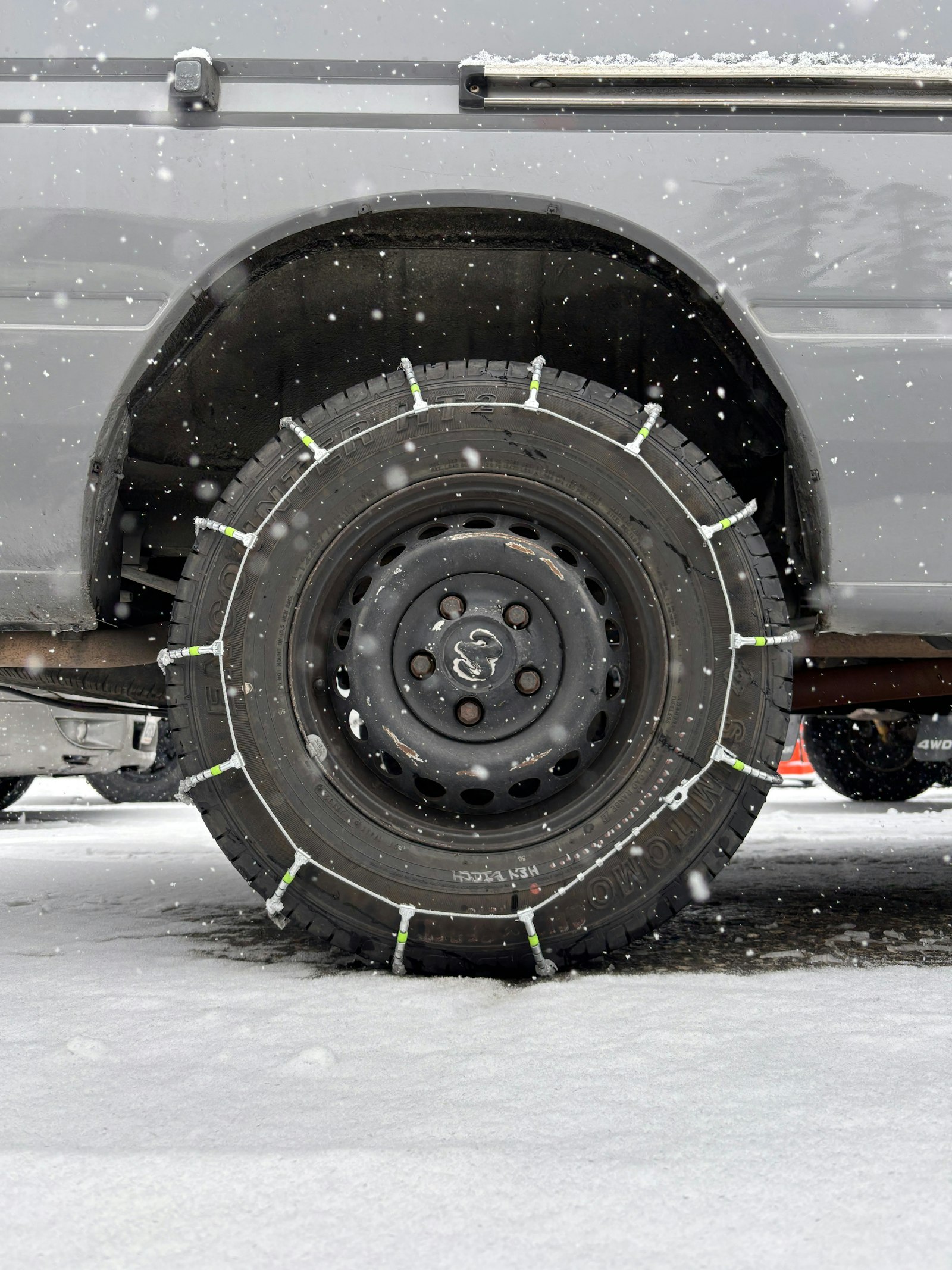
The worst possible time to shop for snow chains is 9 p.m. at a gas station near the bottom of a mountain pass, snow already blowing sideways, a line of brake lights ahead of you, and one dusty box of the wrong size left on the shelf. That box costs triple, fits nothing, and the guy waving a flashlight will still turn you around. Buy chains in August and you pay list price, in daylight, with the exact size for your tires, and you get to practice putting them on in your driveway instead of on your knees in a ditch.
TL;DR: Chains are cheap insurance for anyone who drives into snow country a few times a year, and they are flat out required on certain mountain routes when the signs go up. For most drivers, a self tightening steel set is the easiest thing to live with. Cars with tight wheel wells want a low profile cable set or an externally mounted chain. Textile snow socks are the simplest to put on and store but wear faster on bare pavement. Match the set to your exact tire size, keep them in the trunk, and never drive faster than about 30 mph with any of them on.
Why chains still matter when you already have winter tires
Good winter tires do most of the work most of the time, and if you have not sorted your rubber yet, start with our best winter tires for 2026 rundown before you spend a dime on chains. But tires and chains solve different problems. Winter tires give you grip everywhere. Chains give you brute mechanical bite for the short, ugly stretch where a loaded car is trying to climb an icy grade or ease down one without becoming a sled. On deep snow and glare ice on a slope, nothing a passenger tire can do matches steel or fabric digging in.
There is also the law, which does not care how confident you feel. In California, Caltrans posts three chain control levels. R1 lets most passenger cars through with snow tires on the drive wheels. R2 requires chains on everything except four wheel drive vehicles under 6,500 pounds wearing snow tires on all four corners. R3 means chains or an approved traction device on every vehicle, no exceptions, four wheel drive included. Colorado runs a similar system on the I-70 mountain corridor between Dotsero and Morrison, where a Traction Law sits in effect from September 1 through May 31, and a Passenger Vehicle Chain Law kicks in during the nastiest storms and forces chains or an approved alternative onto every car on the road. Show up without them and you are either turned around or, if you slide and block the highway, ticketed and very unpopular.
The four types, in plain English
Cable chains use thin steel cables with cross traction rollers. They are light, they need very little clearance, and they are the friendliest to install, which is why nervous first timers love them. The tradeoff is they bite a little less than heavy link chains and wear faster if you grind them on dry road.
Diamond and ladder link chains are the classic heavy steel you picture. Diamond patterns give smoother, more constant grip. Ladder patterns are the cheapest and toughest but ride a touch rougher. These bite hardest and last longest, and they need the most wheel well room.
Externally mounted chains attach to the wheel face and ride only on the tread, so they need essentially zero room behind the tire. That makes them the answer for modern cars with almost no gap between tire and strut.
Textile snow socks are woven fabric covers you pull over the tire. They are the lightest, smallest, and fastest to fit, and they are gentle on alloy wheels. They grip ice impressively but shred quickly on bare asphalt, so they are a get me through it tool, not an all winter workhorse.
Our picks for 2026
Best overall for occasional snow travel: the Peerless Auto-Trac. These are the set I hand to anyone who drives to the mountains a few weekends a year and wants to think about it as little as possible. A self tightening ratchet centers and tensions the chains as you drive, so there is no getting out to retighten after 100 feet. You connect the inside cable, clip the two outside tighteners, and go. They meet Class S clearance for cars and light SUVs, and the manganese alloy cross links are short and light. Like almost every set here, keep it under 30 mph.
Best for low clearance cars: the Security Chain Super Z6. If your owner's manual warns about limited space around the drive tires, this cable set is built for you. It needs just a quarter inch of sidewall clearance, uses a diagonal cross member for better all around traction than plain cables, and a split outside cable with two fastening points lets you fit them without moving the car. They also play nicer with ABS, traction control, and all wheel drive than old school link chains.
Best externally mounted set: the Konig K-Summit. This is the premium answer for cars that truly have no room behind the tire, because it bolts to the wheel and rides entirely on the tread with zero inner clearance needed. An integrated ratchet does the tensioning for you, a torque tool clicks when you have it right, and the whole thing folds flat for storage. It costs more than a cable set, and it is worth it if a normal chain would rub your strut or brake line.
Best textile alternative: AutoSock. The original snow sock, made in Norway since 1998, slips over the tire in about three minutes and weighs almost nothing. It is certified to the European EN16662-1 winter traction standard and is accepted as a legal traction device in many places where chains are called for, though not every strict chain control route will wave you through on fabric, so check the specific state before you rely on it. Think of these as the easiest, most trunk friendly option for drivers who hit snow rarely.
Best budget pick: Glacier cable chains. When you need something legal and functional in the trunk without spending much, these low profile cable chains cover most passenger sizes and install without jacking the car. They are not as grippy or as durable as the heavier sets, but for a driver who might use them once a season they are honest value.
Fit and installation gotchas
Chains are sized to your exact tire, and the numbers on your sidewall (something like 225/65R17) are what the fitment chart wants, so read them before you buy. Put chains on the drive wheels. Front wheel drive means the fronts, rear wheel drive means the rears, and for all wheel drive you check the manual because some makers specify a particular axle. Do a dry run in the driveway once, in gloves, in the light, so the real thing in a storm is muscle memory and not a panic. Keep speeds low, avoid spinning the tires, and pull the chains the moment the road turns to bare, wet pavement, because dry asphalt is what chews up cross members and shreds socks. Toss a pair of waterproof gloves in the same bag and your hands will thank you.
One more money note that has nothing to do with chains: if your current car is the reason you dread winter, our when to replace tires guide and the keep or sell calculator can tell you whether another season of snow tires and chains is smarter than trading out now.
Bottom line
For most people the honest answer is a self tightening steel set like the Auto-Trac, bought in your exact size, practiced once, and left in the trunk from October to April. Tight wheel wells push you to a low clearance cable set or an external chain, and drivers who only rarely see snow can get away with textile socks. Whatever you choose, the timing is the real lesson here. The chains you own in August are cheap and correct. The ones you buy in a blizzard are expensive and usually wrong.
FAQ
Do I need snow chains if I already have winter tires?
Not for everyday winter driving, where good winter tires handle it. You need chains for the specific case of steep, icy grades and for legal chain control zones. On California R3 or a Colorado Passenger Vehicle Chain Law day, every vehicle needs chains or an approved traction device.
Chains, cables, or textile socks: which should I actually buy?
Heavy link chains bite hardest and last longest but need the most clearance. Cable chains are lighter and easier and fit tight wheel wells. Textile socks are the simplest to fit and store but wear fastest on bare road. Match the type to your car's clearance and how often you will really use them.
How fast can I drive with snow chains on?
Slowly. Most makers, including Peerless, cap chain use at about 30 mph, and some textile products allow a bit more. Speed builds heat and stress that breaks cross members and shreds socks, so keep it gentle and take them off once the pavement is clear.
Which tires do the chains go on?
The drive wheels. Fronts on a front wheel drive car, rears on a rear wheel drive one. For all wheel drive, check your owner's manual, because some manufacturers specify a particular axle or advise a full set of four.
The Best Windshield De-Icer for 2026 (The $6 Spray That Beats Ten Cold Minutes and a Cracked Windshield)
A can of de-icer clears a frozen windshield in under a minute, and it costs less than a coffee. Here are the sprays and fluids worth keeping in your trunk, the AAA-backed DIY mix that costs pennies, and the hot-water mistake that can turn a frosty morning into a $400 glass bill.
Best Snow Socks for Tires (2026): The Textile Chain Alternative That Fits Your Car
Snow socks slip on in three minutes, cost less than a tank of gas, and get a low-clearance car moving in snow when chains will not fit. Here is which ones to buy, which car each suits, and when to skip socks for chains or winter tires instead.
The Best Remote Car Starters for 2026 (Skip the Dealer's $500 Warm-Up)
Aftermarket remote start done right in 2026, from a DIY kit that runs off your own key fob to a pro-installed system with a lifetime warranty, plus how to dodge the dealer markup.